
Pain management remains one of the most complex challenges in modern medicine, particularly within neurology. The root difficulty lies in the nature of pain itself—a subjective, highly individual sensation influenced by biological, psychological, and environmental factors. For healthcare providers, objectively identifying pain types and tracking fluctuations in clinical routines is no easy task. Infrequent monitoring frequently introduces bias into pharmacotherapy evaluations.
Addressing this challenge, a major medical technology breakthrough was born in Aceh. Prof. Dr. dr. Dessy R. Emril, Sp.N(K), a senior academic and clinician, developed an innovative system named Pain.DREMODE (Pain Digital Regulation Monitoring Device). Created through a collaboration between Dr. Zainoel Abidin Regional General Hospital (RSUZA) Banda Aceh and the Faculty of Medicine at Syiah Kuala University (USK), this innovation integrates digital technology to modernize conventional chronic pain management.
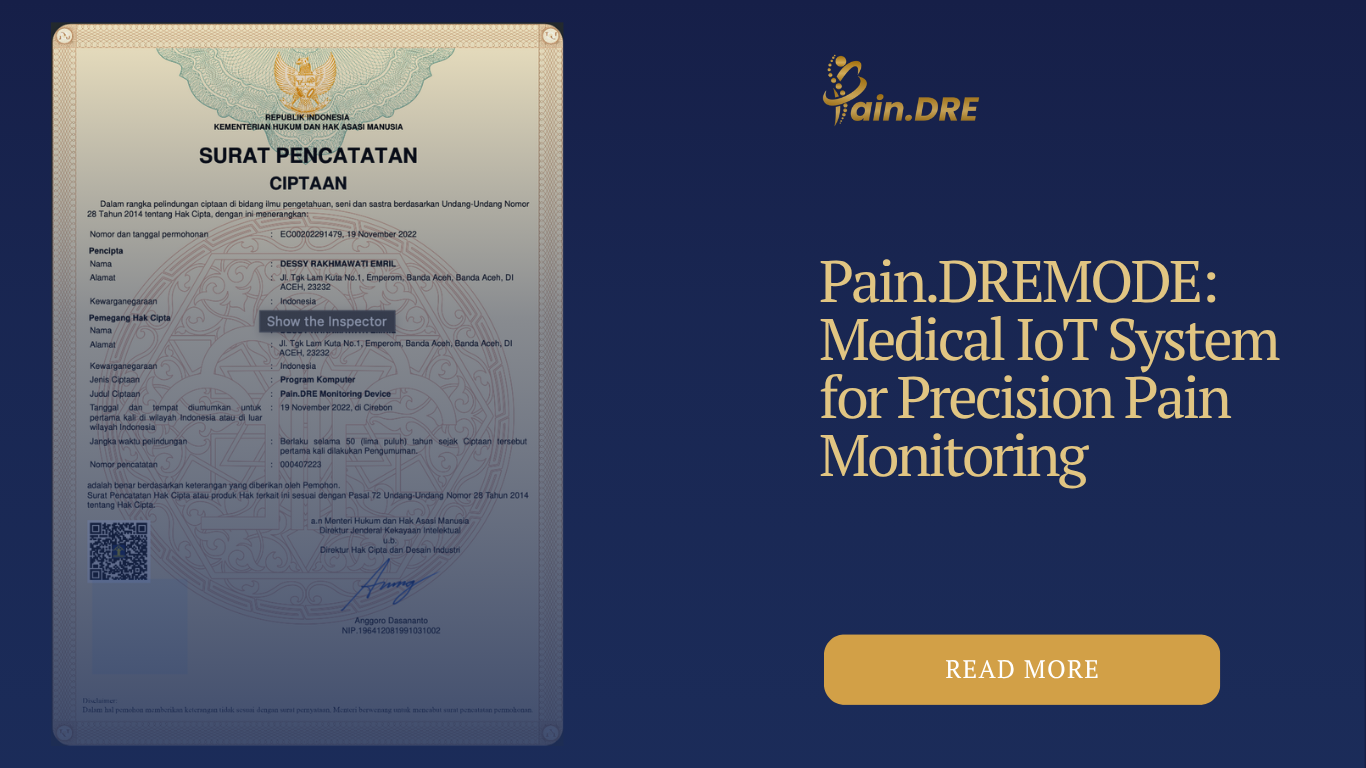
Legally, this intellectual creation is officially registered under the Ministry of Law and Human Rights of the Republic of Indonesia (Record No. 000407223) as a nationally recognized Computer Program. Across the Pain.DRE platform, let’s analyze the technology architecture, clinical features, and scientific validity underpinning this digital pain monitoring application.
Why Is an IoT Approach Needed in Pain Management?
In traditional care, pain tracking relies heavily on a patient’s subjective memory during periodic clinic visits. Patients often struggle to recall precisely when their pain peaked or how their body responded immediately after taking medication over the preceding week.
Pain.DREMODE resolves these limitations by leveraging Internet of Things (IoT) architecture. Utilizing IoT allows an Android-based digital pain monitoring app to connect seamlessly over the internet for real-time data collection. This technology bridges interactions between patients and healthcare providers without distance distortion. Beyond recording pain scores, the platform provides holistic visual data encompassing examination history, diagnostic records, and treatment timelines.
Key Clinical Features of the Pain.DREMODE Application
As an integrated medical computer program, Pain.DREMODE features three core operational pillars designed to enhance clinical accuracy:
- Algorithmic Neurological Screening Tool: Contains a digital screening instrument that assists clinicians in classifying pain types instantly—whether nociceptive (muscular), neuropathic (nerve), or complex mixed components. Accurate initial identification dictates subsequent interventional strategies.
- Synchronized Pain Scale & Medication Timeline Graphing: Automatically compiles patient pain scores into precise trend curves. These graphs correlate checking times directly with medication schedules. Through curve visualization, neurologists objectively evaluate whether prescribed drug therapies effectively control pain or require dosage adjustments.
- Adjustable Alarm System for Pain Re-Evaluation: Includes an adaptive alarm system reminding patients to log pain evaluation data periodically following initial scans or specific medication intake.
Clinical Validity and Performance Excellence
A key parameter confirming Pain.DREMODE’s status as a gold-standard clinical tool is its accuracy, validated in major referral hospital settings. During implementation and evaluation phases, the application demonstrated superior data precision in measuring pain intensity compared to traditional physical tools like pressure algometers.
The program’s success is supported by scientific studies conducted by FK USK researchers titled “Analysis Understanding Module for the Use of Pain Digital Regulation Monitoring Device (Pain.DREMODE) Applications on Health Workers.” Research revealed healthcare workers mastered, understood, and operated the application module with highly satisfactory outcomes, ensuring long-term usability in clinical environments.
Implementing IoT-based technologies in clinical settings presents challenges, from integrating electronic medical records to managing local technical resources. However, through continuous commitment from Prof. Dessy’s Practice and clinical leaders at RSUZA Banda Aceh, system adaptability and communications are evaluated constantly to maintain standardized pain assessment across community and tertiary care levels.
Frequently Asked Questions (FAQ) – Understanding Pain.DREMODE
- Has the Pain.DREMODE application been deployed with real patients?Yes, Pain.DREMODE was officially implemented at Dr. Zainoel Abidin Regional General Hospital (RSUZA) Banda Aceh in December 2023. It assists neurologists in evaluating patient recovery progress using objective pain intensity metrics.
- What makes Pain.DREMODE unique compared to other pain tracking tools?Its uniqueness lies in medical IoT integration. Rather than merely logging numbers, the app intelligently correlates biological responses with prescribed medications in a unified graphical database to guide clinical decision-making.
- Can patients use this app for self-diagnosis?No. Pain.DREMODE functions as a clinical decision support tool used by healthcare providers and neurologists to monitor therapeutic progress precisely. Final diagnoses are always established by specialists through physical and diagnostic examinations.
Moving Toward Integrated Digital Pain Management
The creation of Pain.DREMODE by Prof. Dr. dr. Dessy R. Emril, Sp.N(K) represents a progressive step toward digitizing Indonesian healthcare. Future developments aim to integrate the application with national Electronic Medical Record (EMR) systems to boost efficiency and precision across clinical settings.
If you are managing chronic nerve pain or seeking medical care grounded in data precision, early intervention remains the key to avoiding long-term complications.
Explore our intellectual property portfolio on our Copyrights & Patents (IPR / HAKI) page or review our academic contributions on our Publication Archive & Research Hub.
Consult with our specialist team at Pain.DRE in Banda Aceh via our Clinical Services directory to receive targeted, evidence-based care.
Disclaimer: The information provided in this article is for general educational purposes only and does not substitute for professional medical advice, diagnosis, or treatment by a qualified neurology specialist. Never disregard professional medical advice or delay seeking it because of something you have read on this website. For an accurate assessment of your health condition, please schedule an appointment directly at Prof. Dessy’s Practice.