
In modern oncology discourse, managing chronic pain in cancer patients is a crucial pillar that determines quality of life during primary therapies such as chemotherapy, radiotherapy, or surgical tumor resections. Among the most challenging conditions to treat is neuropathic cancer pain. This pain arises either from direct tumor infiltration into peripheral nerve bundles or as a secondary toxic effect of chemotherapeutic agents that cause nerve fiber damage (chemotherapy-induced peripheral neuropathy, or CIPN).
Conventionally, the first-line pharmacological treatment used to suppress hyper-sensitization in neural circuits is Gabapentin. Gabapentin acts specifically as a ligand at the $\alpha_2\delta$ subunit of voltage-gated calcium channels in the central nervous system, effectively decreasing the release of excitatory neurotransmitters that trigger chronic pain signals.
However, a compelling scientific question arises: Is Gabapentin’s role in oncology care strictly limited to passive pain relief? Or does this molecule possess hidden biological interactions within the tumor microenvironment itself?
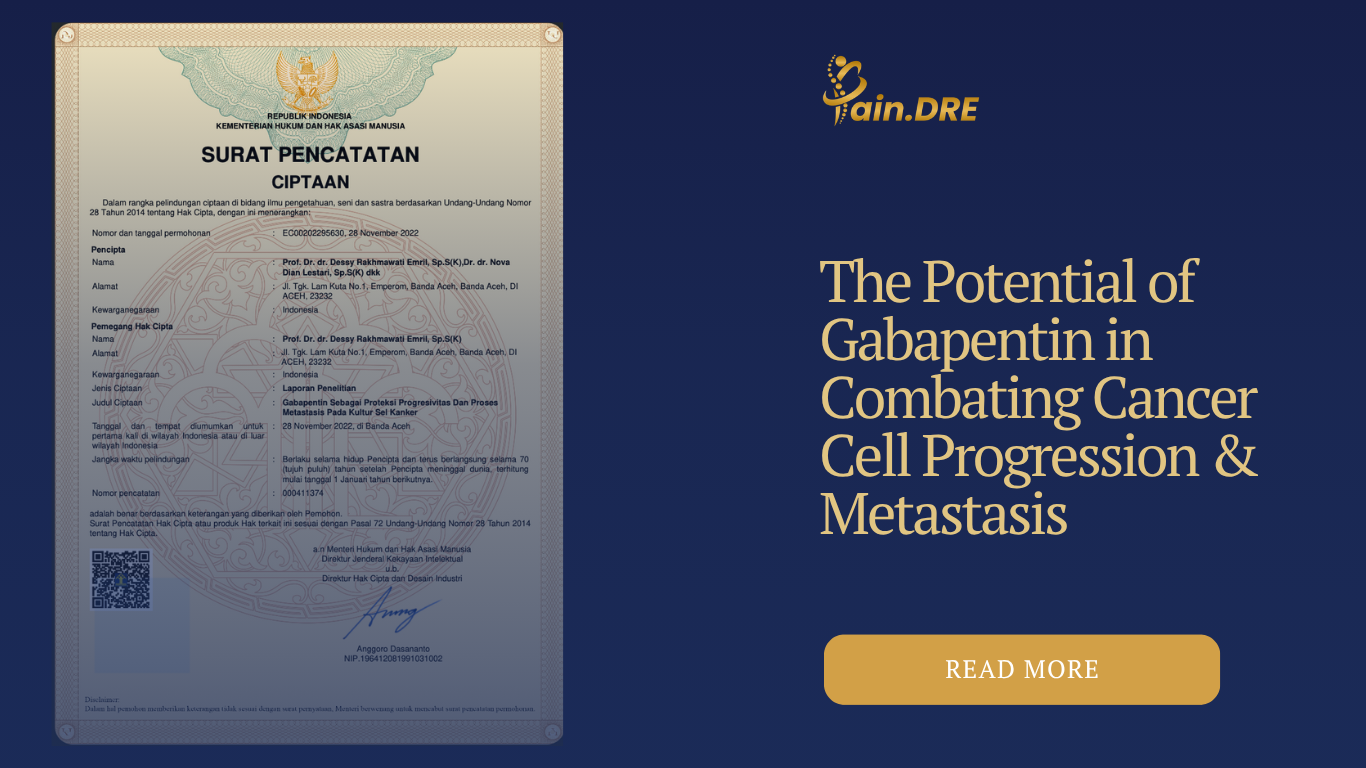
Addressing this academic challenge, a groundbreaking research collaboration was conducted in Indonesia. Senior neurology expert Prof. Dr. dr. Dessy R. Emril, Sp.N(K), alongside Dr. dr. Nova Dian Lestari, Sp.S(K), Dr. dr. Rachmad Suhanda, M.Kes, and dr. Meutia Maulina, M.Si, executed a laboratory-scale study exploring a new dimension of this medication. This landmark research report, titled “Gabapentin as Protection Against Progression and Metastasis Processes in Cancer Cell Cultures,” is officially registered under the Ministry of Law and Human Rights of the Republic of Indonesia with Copyright Registration No. 000411374.
Through the Pain.DRE platform, we analyze the scientific foundation, research methodology, and clinical implications of these findings objectively and with medical accuracy.
Scientific Foundation: Linking Neural Pathways to Cancer Progression
To understand the correlation in this Gabapentin-cancer research, the international research community has increasingly focused on the field of Neuro-Oncology. This discipline investigates how cancer cells hijack surrounding neural pathways and neurotransmitters to grow, invade healthy tissue, and metastasize (spread to other organs).
Voltage-gated calcium channel subunits – the primary target of Gabapentin – are not exclusively expressed in brain and spinal cord tissues. Molecular pathology studies demonstrate that these calcium channel subunits also undergo overexpression across various solid cancer cell cultures. Excessive calcium ion influx into cancer cells triggers intracellular signaling cascades that promote:
- Maladaptive Cellular Proliferation: Accelerating uncontrolled cancer cell division.
- Tissue Migration and Invasion: Enhancing the ability of cancer cells to penetrate the extracellular matrix and migrate toward adjacent blood vessels.
- Metastasis Processes: Facilitating detached cancer cells to survive within the bloodstream and establish secondary colonies in distant organs.
Grounded in this biological background, Prof. Dr. dr. Dessy R. Emril, Sp.N(K) and her team conducted laboratory testing on cancer cell cultures to observe whether blocking calcium channel pathways with Gabapentin exerts a protective or inhibitory effect against aggressive tumor cell behavior.
Laboratory Research Methodology and Preliminary Findings
This research led by Prof. Dr. dr. Dessy R. Emril, Sp.N(K) focused on in vitro observations within integrated educational and research laboratories, involving academic institutions including the Faculty of Medicine at Syiah Kuala University (FK USK) and Dr. Zainoel Abidin Regional General Hospital (RSUZA) Banda Aceh.
Under strictly controlled laboratory conditions, cancer cell cultures were exposed to Gabapentin molecules across various concentration levels tailored to human therapeutic ranges. Primary parameters measured in this study included:
- Cancer cell viability rates and proliferation indices post-drug exposure.
- Horizontal cancer cell migration capabilities using scratch assays to simulate early metastatic potential.
- Molecular modulation suitability along the tumor cells’ voltage-gated calcium channel pathways.
The findings from this research report demonstrate promising outcomes. Gabapentin exhibited clinical potential in protecting tissues against aggressive progression and inhibiting key phases of the metastatic process at the laboratory cell culture level. This suppressive effect strongly indicates that managing neuropathic pain with Gabapentin in advanced cancer patients potentially delivers a dual benefit: dampening neuropathic pain suffering while offering added cellular-level protection against tumor expansion.
Clinical Authority & International Track Record of Prof. Dessy Emril
The commitment of Prof. Dessy’s Practice to advancing biomedical research stems directly from the innovator’s extensive career. As a highly reputed Neurologist in Banda Aceh, Prof. Dr. dr. Dessy R. Emril, Sp.N(K) has served as the Chair of the Pain Study Group of the Indonesian Neurological Association (PERDOSNI) since 2019.
Her international track record is backed by an extensive academic fellowship portfolio:
- Singapore Fellowship: Pain Management Center, Singapore General Hospital (2009).
- Taiwan Fellowship: Musculoskeletal Ultrasound, National Taiwan University Hospital (2016).
As part of the Interventional Pain Management policy formulation team for the Indonesian College of Neurology and the Indonesian Medical Council (KKI), as well as an active contributor with over 52 international scientific publications in pain management, every scientific insight published on Pain.DRE carries validated medical authority.
Clinical Boundaries and Medical Ethics: Avoiding Unsubstantiated Claims
To maintain medical accuracy and ethical standards, it is essential for the public and research communities to understand the scope of these research findings responsibly:
Medical Disclaimer & Research Boundaries:
- Cell Culture Level Research (In Vitro): This study was conducted on cell culture media in a laboratory – an indispensable initial step in pharmacological science. While it provides a strong scientific foundation, further clinical trial phases in living organisms (in vivo) are required before drawing definitive oncological treatment conclusions.
- Not a Replacement for Primary Cancer Therapy: In current oncological protocols, Gabapentin remains an adjuvant therapy for managing cancer-related neuropathic pain, not a substitute for primary regimens such as surgical tumor resection, chemotherapy, or radiotherapy prescribed by your oncology team.
- Requires Specialist Supervision: Dosage regulation, administration, and titration of Gabapentin must be strictly monitored by a Neurologist to prevent adverse side effects.
Frequently Asked Questions (FAQ) – Gabapentin Cancer Research
- Which researchers were involved in this Gabapentin research report?This study was led by Prof. Dr. dr. Dessy R. Emril, Sp.N(K) in collaboration with senior academic researchers from FK USK: Dr. dr. Nova Dian Lestari, Sp.S(K), Dr. dr. Rachmad Suhanda, M.Kes, and dr. Meutia Maulina, M.Si.
- Can cancer patients in Banda Aceh receive this therapy for pain management?Yes. Prescribing Gabapentin to relieve nerve compression and neuropathic pain caused by cancer infiltration is a standard medical procedure applied at Prof. Dessy’s Practice and Dr. Zainoel Abidin Regional General Hospital (RSUZA) Banda Aceh.
- How does Gabapentin inhibit cancer cell spread in laboratory settings?Gabapentin works by blocking voltage-gated calcium channel subunits on tumor cell membranes. This blockade inhibits the influx of calcium ions required by cancer cells to divide and migrate through healthy tissues.
Moving Forward with Evidence-Based Pain Care
Research into Gabapentin’s potential by Prof. Dr. dr. Dessy R. Emril, Sp.N(K) underscores her role as a scientific innovator contributing to neurological advancements. Through rigorous research dedication, clinical care at our practice remains rooted in evidence-based medicine (EBM), prioritizing high standards of safety for every patient.
For medical peers, researchers, or patients interested in exploring our research portfolio and clinical competencies further, feel free to browse our Publication Archive & Research Hub or view our official certifications on our Innovation & Achievements page.
If you or a family member are struggling with chronic pain, neuropathic pain from nerve disorders, or post-cancer therapy pain complications, our team is here to assist. Visit our About Prof. Dessy page to understand our care philosophy, or book a comprehensive consultation via our Clinical Services directory at Pain.DRE in Banda Aceh today.
Disclaimer: The information provided in this article is for general educational purposes only and does not substitute for professional medical advice, diagnosis, or treatment by a qualified neurology specialist. Never disregard professional medical advice or delay seeking it because of something you have read on this website. For an accurate assessment of your health condition, please schedule an appointment directly at Prof. Dessy’s Practice.